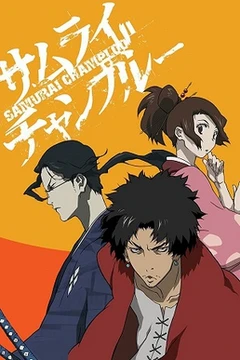
The Shogunate
The iron fist of Edo-period order that hunts the flower-scented samurai.
The Shogunate serves as the overarching political and military authority governing Japan during the Edo period depicted in Samurai Champloo. Led by the shogun in Edo, this vast bureaucracy maintains order through a strict class system, a network of magistrates, and an army of samurai enforcers. While often portrayed as a monolithic force of law, the organization is frequently shown to be riddled with corruption, internal power struggles, and rigid adherence to tradition that stifles individual freedom. In the narrative, the Shogunate acts less as a specific villainous faction and more as the oppressive backdrop against which the protagonists' journey unfolds. Its agents, ranging from local magistrates to elite executioners, constantly pursue Mugen for his crimes or attempt to suppress any disruption to the social order. The group represents the crushing weight of societal expectations that Jin struggles with internally and that Mugen defies with chaotic abandon.
- Type
- Governmental Authority / Military Bureaucracy
- Leader
- The Shogun (based in Edo)
- Key Enforcers
- Magistrates, Samurai Police, Executioners
- Primary Base
- Edo Castle and regional magistrate offices
- Status
- Active throughout the series timeline
- Opposing Forces
- Ronin, bandits, and social outcasts
Lore & Background
The Shogunate's power is absolute yet paradoxically fragile. It relies on the appearance of invincibility to keep the populace in line, utilizing a rigid hierarchy where status determines worth. The government fears anything that disrupts this balance, viewing individuals like Mugen not just as criminals, but as existential threats to the very fabric of society. This fear often leads to overreaction, where local officials prioritize their own reputations and safety over true justice, resulting in bureaucratic incompetence or ruthless brutality. The organization is also a breeding ground for conflict among its own ranks. The series highlights how the pursuit of power within the Shogunate can corrupt even those sworn to uphold the law. High-ranking officials often manipulate lower-level enforcers to settle personal scores or eliminate rivals, revealing that the 'law' is merely a tool for the powerful. This internal rot creates openings for outsiders like Fuu and her companions to navigate the dangers of the road, exploiting the gaps in the Shogunate's surveillance and control.
In Their Own Story
The dust of the main road kicked up by a thousand sandals settled as the magistrate's carriage halted before a small shrine. The local official stepped out, his silk robes pristine against the grime of the journey, flanked by two samurai whose swords hung heavy at their hips. They were not hunting for bandits today; they were inspecting the peace. Yet, in the distance, a silhouette moved with a fluidity that defied the rigid postures of the Shogunate's men. A single flower petal drifted onto the magistrate's polished boot. He froze, his eyes narrowing as he sensed the chaos approaching—a scent of sunflowers and gunpowder that signaled the end of order.
Reader's Guide
The Shogunate operates through a decentralized but connected hierarchy, with the Shogun at the apex in Edo Castle and regional magistrates enforcing will locally. Their primary goal is the preservation of social stability and the suppression of ronin or bandits who threaten the peace. Key members include local magistrates who often act as intermediaries between the people and the law, and elite enforcers like the mysterious executioner who hunts Jin. These agents are bound by duty but frequently driven by personal ambition or fear of failure. The conflict with the protagonists is central to the plot. Mugen is a constant target due to his criminal past and inability to conform to social norms. The Shogunate views him as an unruly element that must be caged. Conversely, Jin represents a different challenge; as a skilled ronin hiding from his past, he evades their grasp not through chaos but by disappearing into the shadows of society they cannot fully control. Fuu often finds herself caught in the crossfire when her search for the sunflower samurai inadvertently draws the attention of Shogunate agents. The group's relentless pursuit forces the trio to constantly move, turning their journey into a cat-and-mouse game where the law is always one step behind.
Did You Know?
- The Shogunate's authority is often challenged by the presence of ronin, masterless samurai who reject the rigid class structure enforced by the government.
- Local magistrates frequently act with significant autonomy, sometimes leading to inconsistent enforcement of laws depending on the region.
- The series depicts the Shogunate as a force that struggles to adapt to the changing times, often relying on outdated traditions to maintain control.
- Elite executioners within the organization are depicted as highly skilled warriors who serve as the ultimate enforcers for high-profile targets.
Origins of the Warrior Class
The emergence of professional warriors in Japan stemmed from the collapse of the imperial conscript system by 792 AD. Conscripts proved unreliable and ineffective against mobile enemies like the Emishi, who utilized mounted archers. Unlike short-term levies, elite combat required years of specialized training in horsemanship and archery, skills that only wealthy families could afford to cultivate privately. Consequently, the state shifted toward recruiting men from these affluent lineages who already possessed the necessary martial expertise and equipment. This transition was accelerated by economic shifts; as tax burdens grew, landowners donated estates to tax-exempt temples or nobles to create private domains known as shōen. Stewards managing these lands often passed their roles hereditarily, gradually evolving into a distinct warrior class. By the 11th and 12th centuries, these bushi were deeply involved in land reclamation and tax evasion strategies, enriching themselves while draining imperial revenues. The expulsion of imperial family members to form the Minamoto and Taira clans further solidified this structure, as provincial families married into them for status, creating powerful warrior lineages that eventually superseded the central government's military authority.
Training and Social Distinction
Samurai were defined by a rigorous commitment to martial arts and cultural refinement that set them apart from common conscripts. From a young age, members of warrior families underwent private instruction in swordsmanship, archery, and horsemanship, disciplines requiring years to master. This extensive training rendered them superior to militia forces, who typically received only days of preparation before deployment. Furthermore, the right to possess weapons like swords was legally restricted to this class for much of Japanese history, reinforcing their unique status. Beyond combat, samurai were expected to be well-rounded bureaucrats and administrators under the shoguns. Their education included literature, calligraphy, and Confucian philosophy, preparing them for governance roles alongside their military duties. Terminologically, while English scholars often use 'samurai' and 'bushi' interchangeably, a distinction existed: 'bushi' referred to the warrior class broadly, whereas 'samurai' specifically denoted retainers serving a lord. Warlords like daimyo were bushi but not samurai in this strict sense. Even those who lost their masters, known as ronin, retained certain warrior privileges, such as the right to bear arms and use surnames, though they no longer served a specific overlord.
Transformation Under Tokugawa Rule
The role of the warrior estate underwent a profound transformation during the prolonged peace of the Tokugawa shogunate. As military conflict diminished, the samurai evolved from active combatants into a hereditary administrative class serving domain governments. Many took on roles as officials, police officers, teachers, or local administrators while maintaining their traditional privileges, including stipends and the exclusive right to wear swords. This era solidified their status distinction within society, even as their primary function shifted toward governance rather than warfare. The institutional basis of this class was eventually dismantled following the Meiji Restoration. The abolition of domains, the introduction of universal conscription, and the removal of hereditary stipends stripped samurai of their economic foundation. Additionally, laws prohibiting civilian sword-wearing removed a key symbol of their authority. Former feudal lords were reorganized into the kazoku nobility alongside court aristocrats, while the majority of former warriors became shizoku. Although these classes remained legally recognized until 1947, by the 1918 census, they represented only a tiny fraction of the population, marking the end of their dominance.
Economic Foundations and Decline
The rise and eventual dissolution of the samurai class were deeply rooted in Japan's economic structures. Initially, wealthy families funded private military training because the state could not afford to equip or train conscripts for specialized roles like mounted archery. This wealth was often tied to land ownership and tax evasion strategies involving shōen estates, which allowed warrior families to accumulate resources while reducing imperial revenue. However, this same economic model contributed to their decline. The Meiji government's reforms targeted the feudal system directly by abolishing domains and commutating hereditary stipends into lump-sum payments or bonds, effectively ending the guaranteed income that sustained the warrior class. With the introduction of conscription, the monopoly on military service was broken, rendering the samurai's martial skills less unique. The removal of privileges like sword-wearing further eroded their social standing. While former lords joined the new kazoku nobility, most warriors were reclassified as shizoku, a status that held little power in modern Japan. By 1918, these groups comprised merely 4.06% and 0.01% of the population respectively, illustrating how swiftly economic policy could dismantle centuries-old social hierarchies.
Gallery


Frequently Asked Questions
Who is The Shogunate?
It serves as the overarching military government ruling Japan during the Edo period depicted in the series. This authority operates primarily out of Edo Castle under the command of the Shogun.
What are The Shogunate's powers and role?
They maintain societal order through a strict class system enforced by magistrates, samurai police, and executioners. Their bureaucracy acts as the primary law enforcement network throughout the region.
How does The Shogunate's story end?
Unlike specific antagonists, this organization remains active and unchanged throughout the entire timeline of the show. They are never overthrown or defeated by the main cast during their journey.
Why is The Shogunate important to the plot?
Their rigid laws create the conflict that drives ronin like Jin and Mugen into constant trouble with the law. They represent the oppressive status quo the characters often clash against while searching for the samurai who smells of sunflowers.
Is The Shogunate considered a villainous faction?
While they hunt the protagonists, they function more as a corrupt system than a traditional evil clan seeking personal revenge. Their actions stem from bureaucratic duty and internal power struggles rather than singular malice.
More in Clans & Criminal Groups
Elsewhere in the Samurai Champloo universe
Spotted an error? Know more?
This is a living reference — every entry is fact-audited, and reader corrections feed straight into our audit queue. Suggest an edit · See this site's audit record